

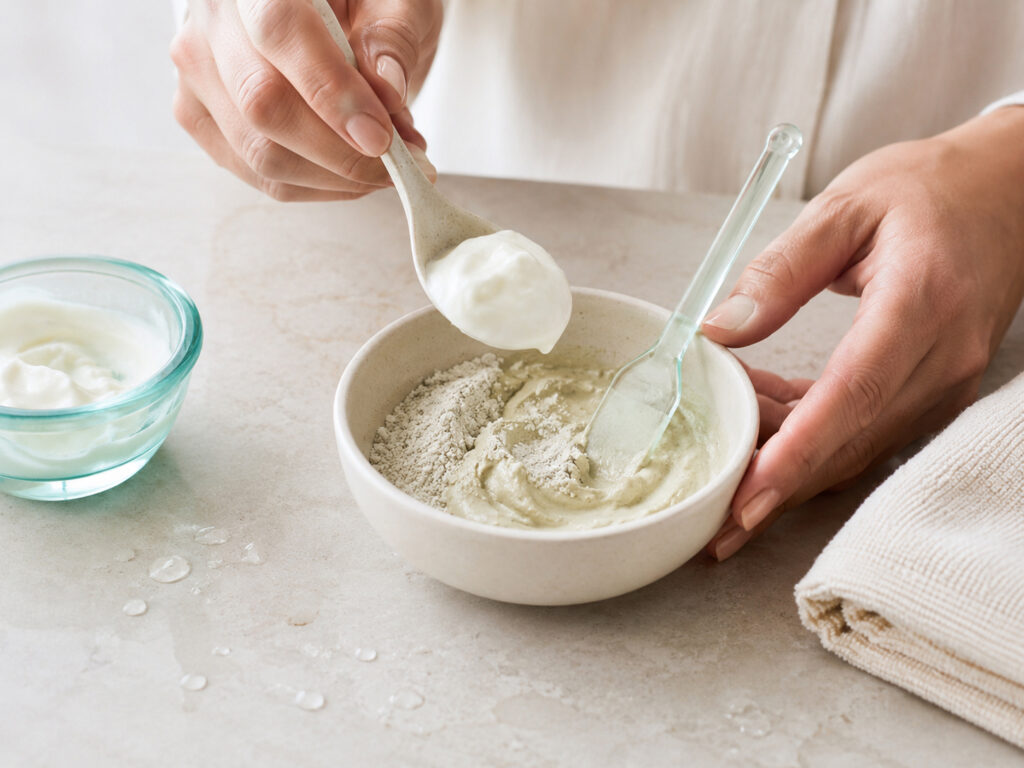
Powder masks have a small advantage that ready-made masks cannot offer: the ritual begins only when you decide to activate them.
You control the consistency. You control the freshness. And with one simple adjustment, you can also influence how quickly the mixture begins to dry on the skin.
The usual method is to mix a powder mask with water. It is clean, simple and effective—but water-based mixtures can begin losing moisture quickly, especially in a warm room or when applied in a very thin layer.
The slow-dry yoghurt trick creates a creamier alternative.
Why Mix a Powder Mask with Yoghurt?
Plain yoghurt has a naturally thicker structure than water. When blended with a powder mask, it creates a denser, softer paste that tends to remain creamy on the skin for longer.
This does not mean that yoghurt makes PDRN more active or pushes ingredients deeper into the skin.
The advantage is practical rather than pharmaceutical: the mask remains easier to spread, feels less brittle as it sits and is less likely to dry into a tight, cracked layer before the ritual is complete.
Think of it as extending the mask’s moist phase—not extending its official application time.
The Slow-Dry Yoghurt Mask Recipe
You will need:
- one dose of PHYTOCODE Face Mask-Scrub with PDRN;
- plain, unsweetened yoghurt;
- a clean ceramic or glass bowl;
- a clean spoon, spatula or mask brush;
- a few drops of clean water for adjusting the consistency;
- a soft face cloth for rinsing, if desired.
Choose plain yoghurt without added sugar, fruit, flavourings, sweeteners or granola. A smooth natural yoghurt is easier to mix and introduces fewer unnecessary ingredients into the ritual.
Suggested starting quantities:
- For a 3 g dose: begin with approximately half a teaspoon of yoghurt.
- For a 5 g dose: begin with approximately one teaspoon of yoghurt.
These are starting points rather than strict laboratory ratios. Yoghurt varies in thickness, so always begin with less and adjust gradually.
How to Prepare the Mask
- Place the powder in a clean bowl. Make sure the bowl and mixing tool are completely clean and dry before beginning.
- Add the yoghurt gradually. Do not pour in the entire amount immediately. Add a small portion and begin mixing.
- Fold rather than whisk. Use slow circular movements to combine the ingredients without introducing excessive air bubbles.
- Adjust with water. If the mixture feels too dense, add clean water one or two drops at a time.
- Aim for a soft cream texture. The mask should hold its shape on the spatula but spread easily without dragging the skin.
- Use immediately. Once yoghurt and liquid have been introduced, the mixture should not be stored for later use.
The Ideal Consistency
A good mask mixture should resemble thick natural yoghurt or a soft facial cream.
If it runs down the face, it contains too much liquid.
If it breaks into dry pieces while spreading, it needs a few more drops of water or yoghurt.
If it forms a smooth, continuous layer without dripping, the balance is right.
The goal is not to create the thickest possible mask. It is to create a layer that stays in contact with the skin without becoming heavy or uncomfortable.
How to Apply It
- Cleanse the face first. Remove makeup, sunscreen and surface residue, then pat the skin gently dry.
- Apply an even layer. Spread the freshly mixed mask over the face while avoiding the immediate eye contour, lips, nostrils and any irritated areas.
- Massage with restraint. Use light circular fingertip movements without pressing or scrubbing aggressively.
- Leave on for 5–10 minutes. The yoghurt variation may remain creamier, but the manufacturer’s recommended application time should still be respected.
- Do not wait for complete cracking. A mask does not need to become rigid to have completed its ritual.
- Rinse with lukewarm water. Add a little water first and massage gently to soften the layer before rinsing it away completely.
- Finish with hydration. Follow with toner, serum or moisturiser according to your usual routine.
The Most Important Rule: Keep the Mask Moist, Not Longer
A slower-drying texture may make the application more pleasant, but it is not an invitation to leave the mask on for twenty or thirty minutes.
Longer does not automatically mean more effective.
PHYTOCODE recommends leaving Face Mask-Scrub with PDRN on the skin for 5–10 minutes. The yoghurt trick should improve the condition of the mixture during that period—not rewrite the product instructions.
If the mask begins to feel tight before the time is complete, lightly dampen your fingertips and press them over the surface. Do not repeatedly spray the face or keep the mixture wet indefinitely.
Why a Powder Mask Works Well for DIY Rituals
PHYTOCODE Face Mask-Scrub with PDRN is supplied as a preservative-free powder. Its formula contains corn seed flour, smooth polylactic-acid exfoliating particles, apple fibre, Sodium DNA and a milk ferment derived from Lactobacillus and Streptococcus thermophilus.
Because the product remains dry until the moment of use, you can prepare only the quantity needed for one fresh application.
The powder format also allows the texture to be adapted:
- less liquid for a denser mask;
- more liquid for a lighter application;
- water for the original ritual;
- plain yoghurt for a creamier, slower-drying variation.
The yoghurt variation changes the sensory experience. It should not be described as increasing the biological activity of the PDRN or replacing the fermented cosmetic ingredient already present in the formula.
Water or Yoghurt: Which Version Should You Choose?
Choose water when:
- you want the simplest version of the official ritual;
- your skin is oily or easily congested;
- you prefer a lighter mask texture;
- you have a known sensitivity or allergy to milk proteins;
- your skin is reactive and you want to minimise additional ingredients.
Choose plain yoghurt when:
- the water-mixed mask dries too quickly in your environment;
- you prefer a softer, creamier application;
- your skin feels comfortable with plain dairy products;
- you want the mask to remain workable throughout the recommended application period.
The Half-and-Half Variation
If pure yoghurt creates a mixture that feels too rich, use a hybrid method.
Begin by mixing the powder with a small amount of plain yoghurt. Then add water drop by drop until the texture becomes lighter and easier to spread.
This variation retains some of the creaminess of yoghurt while remaining closer to the original water-activated ritual.
What Not to Add
DIY skincare becomes less intelligent when the kitchen cupboard turns into an uncontrolled formulation laboratory.
Do not add:
- lemon or other citrus juice;
- baking soda;
- vinegar;
- essential oils;
- perfume or fragrance oils;
- salt or sugar crystals;
- raw egg;
- strong exfoliating acids;
- retinol products;
- additional facial scrubs.
These additions are unnecessary and may increase the risk of irritation, dryness or excessive exfoliation.
The mask already contains exfoliating particles. It does not need to be transformed into something harsher.
Fresh Means Fresh
Once the powder is mixed with water or yoghurt, use it immediately.
Do not place the remaining mixture in the refrigerator for the next day. Do not return unused material to the original package. Do not prepare several portions in advance.
The original powder is preservative-free. Introducing fresh food and water creates a new mixture that has not been formulated or tested for storage.
Prepare one ritual. Use it once. Discard anything left behind.
When to Skip the Yoghurt Variation
Avoid this DIY version if you have a known milk-protein allergy or if dairy products have previously caused redness, itching or swelling on your skin.
Do not apply the mask to broken, sunburned, freshly shaved or actively inflamed skin.
If you have very sensitive skin, rosacea, eczema or an impaired skin barrier, test a small freshly mixed amount first and consider using the original water-based preparation instead.
Wash the mask off immediately if you experience persistent burning, strong stinging, itching or increasing redness.
A Better Ritual Is Not Always a More Complicated One
The yoghurt trick works because it changes one simple physical quality: the way the mask holds moisture while sitting on the skin.
No dramatic chemistry. No miracle ingredient added at the last moment.
Only a creamier texture, a slower transition towards dryness and a little more control over the experience.
The intelligence of the ritual lies in knowing where to stop.