

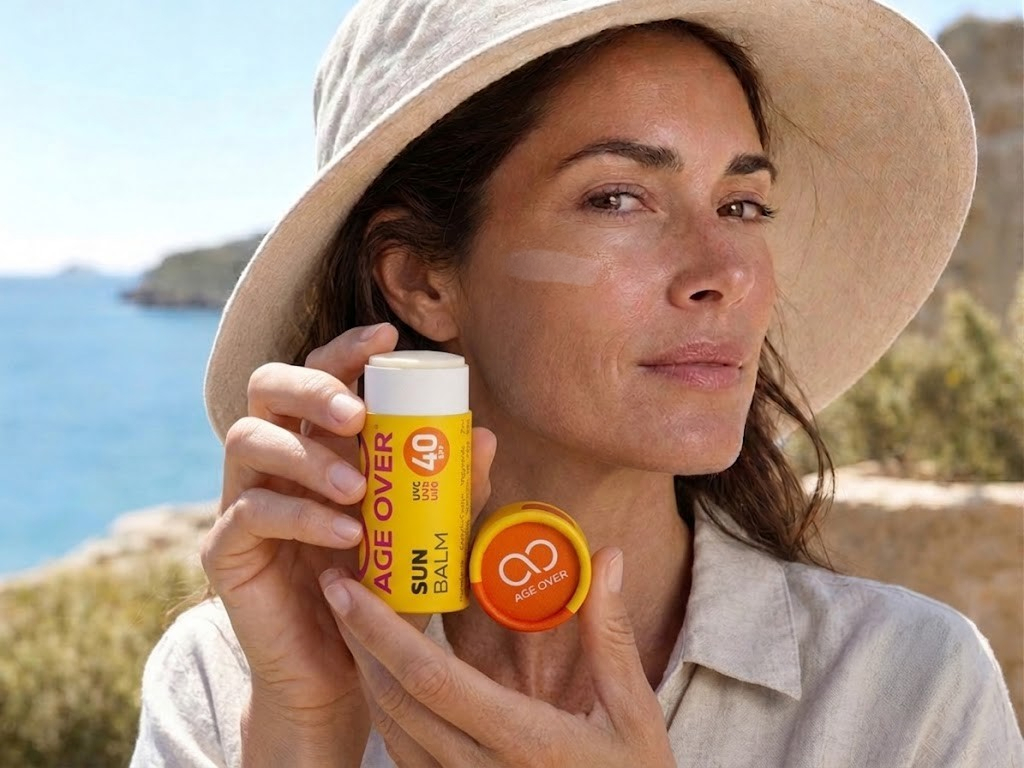
The SPF number is printed clearly on the packaging.
The protective layer it depends on is almost invisible.
This is where many sunscreen routines begin to fail. The product may offer high protection, but the skin receives a thin line across one cheek, a quick pass over the nose and almost nothing around the ears, jawline or neck.
Sun protection does not live inside the number alone. It is built across the skin—area by area, edge by edge, layer by layer.
What SPF Actually Measures
SPF describes the level of protection a sunscreen provides against the UV radiation primarily responsible for sunburn when the product is applied under standardised testing conditions.
It does not mean that SPF 40 allows someone to remain in the sun forty times longer without consequence.
It also does not mean that one quick application creates permanent protection for the rest of the day.
The SPF value depends on several practical conditions:
- using a sufficient amount of product;
- covering the exposed skin evenly;
- avoiding gaps and very thin areas;
- reapplying as the layer is disturbed;
- combining sunscreen with shade, clothing and sensible sun behaviour.
The number describes the potential of the formula. The application determines how much of that potential reaches the skin.
Why a Thin Layer Changes Everything
Sunscreen is tested at a defined application density. In everyday life, however, people frequently apply less than the amount used during testing.
When the applied layer becomes too thin or uneven, the protection achieved on the skin may be substantially lower than the number printed on the pack.
This is not simply a question of quantity. Distribution matters as well.
A generous amount concentrated in the centre of the face cannot compensate for unprotected ears, temples, hairline or neck.
Think of sunscreen as a roof.
A strong material does not protect the room when sections of the roof are missing.
The Advantage of a Solid Sun Balm
A solid sunscreen balm changes the application ritual.
There is no liquid running between the fingers, no cream spilling inside a bag and no need to estimate a large pool of product in the palm before beginning.
The balm can be applied directly to selected areas of the face and body. Its compact form makes it practical for travel, walking, sport and repeated application outdoors.
But convenience creates its own responsibility.
One narrow swipe should not be mistaken for complete coverage. The balm needs to be passed across each area methodically, with overlapping movements, and then distributed where necessary with clean fingertips.
The Overlapping-Pass Method
A sunscreen stick or balm should not draw isolated lines across the skin.
It should build one continuous layer.
- Reveal only a small amount of balm. Push the base of the paper tube gently. Extending too much product may make the stick less stable, especially in warm conditions.
- Begin with clean, dry skin. Heavy moisture, perspiration or oily residue may make controlled application more difficult.
- Work one zone at a time. Divide the face into forehead, each cheek, nose, chin, jawline and exposed neck.
- Use slow, overlapping passes. Allow each movement to cross slightly over the previous one so that narrow gaps are not left between them.
- Change direction where useful. A second light pass in another direction can help create more even coverage across larger or curved areas.
- Blend the edges. Use clean fingertips around the hairline, sides of the nose, eyebrows, beard line and ears, taking care to avoid the eyes.
- Inspect the complete area. Do not look only for visible white residue. Look for places the balm may not have physically reached.
There is no universal number of swipes suitable for every balm, face or body area.
The more reliable principle is visible method: generous product, overlapping application and complete coverage.
The Areas Most Often Forgotten
Sun exposure does not stop where the skincare routine becomes inconvenient.
Pay particular attention to:
- the bridge and sides of the nose;
- the temples and hairline;
- the tops and backs of the ears;
- the space beneath the lower lip;
- the jawline;
- the front, sides and back of the neck;
- the upper chest when exposed;
- the backs of the hands;
- the shoulders;
- the tops of the feet;
- areas of exposed or thinning scalp.
A compact balm is especially useful for these smaller zones because it allows controlled, direct application.
Its precision should be used to complete the protective layer—not merely to touch the most obvious points of the face.
Face Application: A Practical Sequence
Applying sunscreen in a fixed order reduces the chance of forgetting an area.
- Forehead: glide the balm across the forehead using overlapping horizontal movements, then blend carefully towards the hairline.
- Cheeks: work from the centre of each cheek towards the ears without stopping before the outer edge of the face.
- Nose: cover the bridge, sides and tip using controlled movements.
- Upper lip and chin: apply carefully without allowing the product to enter the mouth.
- Jawline: continue beneath the visible edge of the face.
- Neck: carry the product down across every exposed surface, including the sides and back when uncovered.
- Ears: apply carefully over the outer ear and behind it where exposed.
Allow the layer to settle before applying makeup or touching the face repeatedly.
Application Across the Body
On larger areas, scattered stripes are not enough.
Apply the balm in parallel overlapping lines across the exposed skin. Then add another set of light passes at a different angle where necessary.
Use the hands to smooth the product into one continuous layer, especially around curved areas such as shoulders, elbows and knees.
Do not rely on the sensation of product on the skin as proof that every area is protected. A rich balm texture can feel present even when sections remain uncovered.
Visual sequence and deliberate movement are more reliable than memory.
Reapplication Is Not a Sign That the Product Has Failed
The sunscreen layer lives on a moving surface.
It is touched by hands, clothes, towels, water and perspiration. It moves with facial expressions and is gradually disturbed through ordinary activity.
Reapplication restores that changing layer.
Apply again frequently, particularly:
- after swimming;
- after significant perspiration;
- after towel drying;
- after rubbing or wiping the skin;
- when clothing or equipment repeatedly touches an exposed area;
- during prolonged time outdoors.
Do not wait for the skin to feel hot or begin changing colour. Those are late signals, not reminders.
Sunscreen Over Makeup
Reapplying sun protection over makeup requires compromise.
Use short, light passes rather than dragging the balm forcefully across the face. Press and distribute the product gently with clean fingertips where needed.
Some movement of makeup may still occur. Cosmetic perfection should not take priority over maintaining the sunscreen layer during significant exposure.
For a long outdoor day, a simpler makeup base can make reapplication easier and more realistic.
Zinc Oxide Is the Filter—Not Every Ingredient in the Balm
AGEOVER Sun Balm 40 SPF uses Zinc Oxide as its mineral ultraviolet filter.
The rest of the formula supports texture, spreadability, structure and skin comfort:
- Caprylic/Capric Triglyceride helps the balm glide smoothly over the skin.
- Hydrogenated Vegetable Oil supports the solid structure of the stick.
- Beeswax contributes to the protective balm texture and moisture retention.
- Cetearyl Alcohol supports texture, consistency and a smooth skin feel.
- Squalane helps maintain softness and comfort.
- Polyhydroxystearic Acid helps disperse the mineral filter throughout the formula.
- Sodium DNA supports a conditioned and revitalised-looking skin appearance.
Sodium DNA, squalane and the nourishing emollients complement the skincare character of the formula.
They do not create the SPF value. The ultraviolet protection is provided by the sunscreen filter system and depends on correct application.
Mineral Does Not Mean Indestructible
The word “mineral” can create the false impression of a layer that remains permanently fixed to the skin.
But mineral sunscreen is still a topical product.
It can be removed, displaced, diluted or wiped away. It still needs to be applied generously and renewed during exposure.
No sunscreen should be treated as permission to remain indefinitely beneath intense sunlight.
Sun Protection Is a System
Sunscreen is one wall of the shelter—not the entire building.
A stronger daily strategy includes:
- seeking shade when sunlight is intense;
- using a wide-brimmed hat;
- wearing suitable protective clothing;
- protecting the eyes with appropriate sunglasses;
- limiting unnecessary prolonged exposure;
- keeping babies and young children out of direct sunlight;
- reapplying sunscreen rather than relying on one morning application.
The best sun protection is layered in more than one sense: product, fabric, shade, timing and behaviour.
Heat Matters to the Balm Too
A solid balm softens with warmth.
This can improve glide on contact with the skin, but excessive heat may affect the texture and stability of the stick.
Store the product in a cool, dry place away from direct sunlight and excessive heat.
Do not leave it exposed on a hot surface, inside a closed vehicle or directly under the sun for prolonged periods.
Reveal only the amount needed for application and return the balm to its closed form afterwards.
A Compact Product Still Requires a Complete Ritual
AGEOVER Sun Balm 40 SPF is presented in a practical push-up paper tube and is available in 30 ml and 50 ml sizes.
Its solid format is designed for direct, controlled application to the face and exposed areas of the body.
The compact packaging makes the balm easy to carry. But portability becomes valuable only when the product is actually taken out and reapplied.
The best sunscreen is not the one left perfectly preserved inside a bag.
It is the one forming a continuous, generous and renewed layer on the skin.
The Protection Is Built by the Hand
SPF 40 is the capability written on the tube.
The hand determines whether that capability becomes an unbroken layer or a collection of disconnected lines.
Move slowly.
Overlap every pass.
Remember the edges.
Return before the layer disappears.
Sun protection is not one gesture performed in the morning. It is a structure maintained throughout the day.